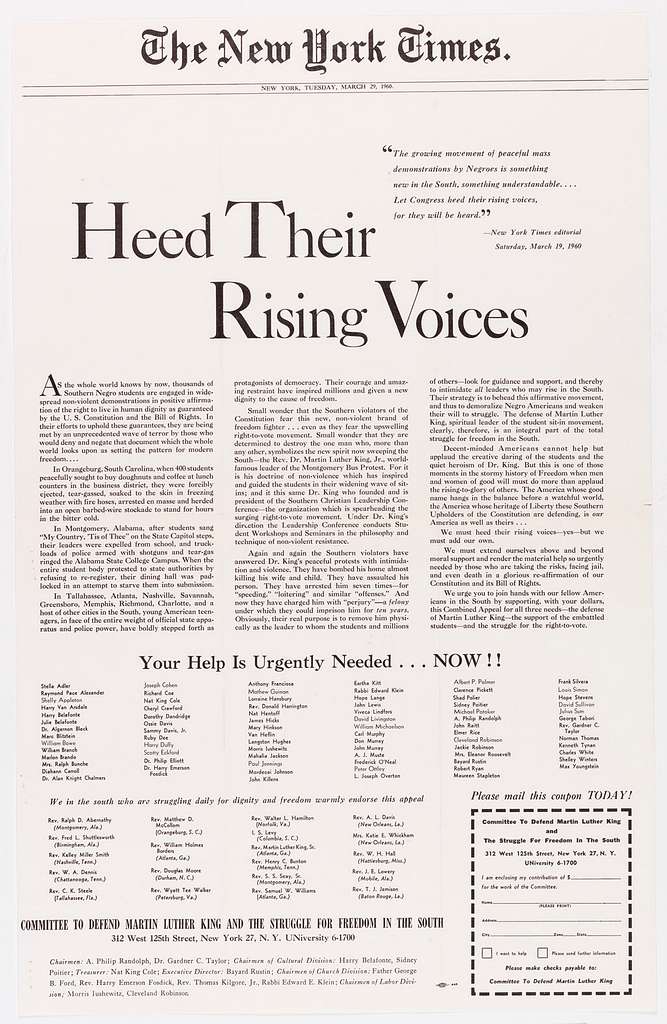
Sullivan was a defamation case decided in the throes of the Civil Rights Movement that was then surging throughout the United States. The New York Times published a full-page advertisement on behalf of African Americans and clergymen in Alabama who were then combatting the Jim Crow laws; the ad accused various Alabama officials of violence and other wrongdoing, but many specific statements were conceded afterward to have been false. The question, which endures to this day, is how much falsity does the First Amendment tolerate in the context of political speech and public officials?
Excerpt: Majority Opinion, Justice William Brennan
The general proposition that freedom of expression upon public questions is secured by the First Amendment has long been settled by our decisions. The constitutional safeguard, we have said, ‘was fashioned to assure unfettered interchange of ideas for the bringing about of political and social changes desired by the people.’ ‘The maintenance of the opportunity for free political discussion to the end that government may be responsive to the will of the people and that changes may be obtained by lawful means, an opportunity essential to the security of the Republic, is a fundamental principle of our constitutional system.’ . . . The First Amendment, said Judge Learned Hand, ‘presupposes that right conclusions are more likely to be gathered out of a multitude of tongues, than through any kind of authoritative selection. To many this is, and always will be, folly; but we have staked upon it our all.’ . . .
Thus we consider this case against the background of a profound national commitment to the principle that debate on public issues should be uninhibited, robust, and wide-open, and that it may well include vehement, caustic, and sometimes unpleasantly sharp attacks on government and public officials. The present advertisement, as an expression of grievance and protest on one of the major public issues of our time, would seem clearly to qualify for the constitutional protection. The question is whether it forfeits that protection by the falsity of some of its factual statements and by its alleged defamation of respondent. . . .
This is the lesson to be drawn from the great controversy over the Sedition Act of 1798, which first crystallized a national awareness of the central meaning of the First Amendment. . . . [T]he Act was vigorously condemned as unconstitutional in an attack joined in by Jefferson and Madison. . . . Although the Sedition Act was never tested in this Court, the attack upon its validity has carried the day in the court of history. Fines levied in its prosecution were repaid by Act of Congress on the ground that it was unconstitutional. . . . Jefferson, as President, pardoned those who had been convicted and sentenced under the Act . . . . These views reflect a broad consensus that the Act, because of the restraint it imposed upon criticism of government and public officials, was inconsistent with the First Amendment. . . .
A rule compelling the critic of official conduct to guarantee the truth of all his factual assertions—and to do so on pain of libel judgments virtually unlimited in amount—leads to . . . ‘self-censorship.’ Allowance of the defense of truth, with the burden of proving it on the defendant, does not mean that only false speech will be deterred. . . . Under such a rule, would-be critics of official conduct may be deterred from voicing their criticism, even though it is believed to be true and even though it is in fact true, because of doubt whether it can be proved in court or fear of the expense of having to do so. . . . The rule thus dampens the vigor and limits the variety of public debate. It is inconsistent with the First and Fourteenth Amendments.
The constitutional guarantees require, we think, a federal rule that prohibits a public official from recovering damages for a defamatory falsehood relating to his official conduct unless he proves that the statement was made with ‘actual malice’—that is, with knowledge that it was false or with reckless disregard of whether it was false or not. . . .


Leave a Reply