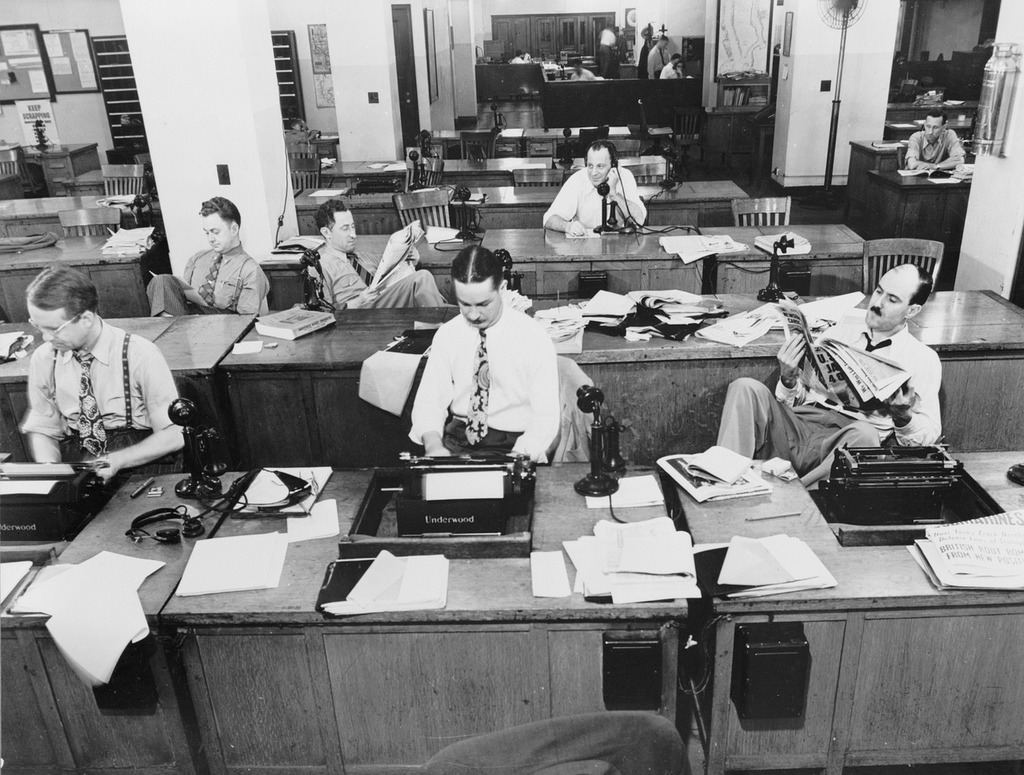
In 1920, journalist Walter Lippmann published a book called Liberty and The News. It was a cry from the heart about the way journalism could fight lies and help the American public get the truth.
We all have a common foe according to Lippmann.
“The real enemy is ignorance, from which all of us, conservative, liberal, and revolutionary, suffer.”
That’s where journalism and the news comes in.
He wrote, “…the chief purpose of “news” is to enable mankind to live successfully toward the future.”
He advocated for clarity and truth.
“True opinions can prevail only if the facts to which they refer are known; if they are not known, false ideas are just as effective as true ones, if not a little more effective.”
Liberty he wrote depends on it.
“The task of liberty … falls roughly under three heads, protection of the sources of the news, organization of the news so as to make it comprehensible, and education of human response.”
He didn’t say that journalism would solve all problems.
But he did write, “the press is no substitute for institutions.” It is he said, “… like the beam of a searchlight that moves restlessly about, bringing one episode and then another out of darkness into vision,” but “men cannot do the work of the world in this light alone.”
He cautioned that reporters, journalists should work with integrity.
“Observation must precede every other activity, and the public observer (that is, the reporter) is a man of critical value. No amount of money or effort spent in fitting the right men for this work could possibly be wasted, for the health of society depends upon the quality of the information it receives.”
Lippmann pointed out that journalism requires hard work.
The cynicism of the trade needs to be abandoned, for the true patterns of the journalistic apprentice are not the slick persons who scoop the news, but the patient and fearless men of science who have labored to see what the world really is. It does not matter that the news is not susceptible of mathematical statement. In fact, just because news is complex and slippery, good reporting requires the exercise of the highest of the scientific virtues.
He said the public needed to be discerning.
You can judge the general reliability of any observer most easily by the estimate he puts upon the reliability of his own report. If you have no facts of your own with which to check him, the best rough measurement is to wait and see whether he is aware of any limitations in himself; whether he knows that he saw only part of the event he describes; and whether he has any background of knowledge against which he can set what he thinks he has seen.
A good reporter needs to know about their community and the world.
The good reporter reads events with an intuition trained by wide personal experience. The poor reporter cannot read them, because he is not even aware that there is anything in particular to read. And then the reporter needs a general sense of what the world is doing. Emphatically he ought not to be serving a cause, no matter how good.
He urged people to look outside their comfort zone for information.
He wrote, “a community cannot rest content to learn the truth about the Democrats by reading the Republican papers, and the truth about the Republicans by reading the Democratic papers. There is room, and there is need, for disinterested reporting; and if this sounds like a counsel of perfection now, it is only because the science of public opinion is still at the point.”


Leave a Reply